

The Political Breakdown: American Politics
Are you frustrated with political games and media spin? Is It Allgood Politics, led by Avee Allgood, digs deep into political issues to uncover the truth behind media narratives, expose hidden agendas, and show where we can come together. Insulting voters or dismissing their beliefs only deepens the divide and erodes trust. Instead, my goal is to offer a space where all perspectives are examined and all voices are valued, creating an informed citizenry empowered to make their own choices. Importantly, our work is NOT about advocating for one side or party. It’s about equipping you—the voter—with the tools and knowledge to form your own opinions. Thus, I am NOT here to tell you which policies are best for you or who to vote for; I am here to hold politicians accountable, uncover the full picture, and foster a political culture rooted in fairness and respect. WE DON’T PROMOTE OR FOCUS ON ANY SINGLE PARTY!As a reminder, Avee Allgood offers rigorously researched insights that encourages critical thinking and objectivity. Our analysis covers a wide range of political perspectives to help readers understand the complexities of political discourse without aligning with any specific party or ideology. Categories
All
|
To keep our work going and improve our services, please consider subscribing or supporting via a one-time donation. |
Part 1The Historical, Religious, and Cultural Significance of CanaanIn this two-part series, we will explore the rich, complex history of the land historically known as Canaan, focusing on its ancient significance and how its legacy has shaped modern geopolitics. Part 1: In Part 1, we dive deep into the historical, religious, and cultural importance of Canaan, an ancient region corresponding to modern-day Israel, Gaza, the West Bank, Jordan, Lebanon, and Syria. Known in the Bible as the Promised Land given to the Israelites, Canaan’s history is far more intricate than biblical accounts suggest. Archaeological evidence from the Bronze Age (circa 3000–1200 BCE) reveals a vibrant network of city-states long before the Israelites’ arrival. This article traces Canaan’s history from the Bronze Age through the rise of the Israelite kingdoms, the arrival of the Philistines, and the enduring importance of Jerusalem as a spiritual and political hub. In doing so, we uncover how Canaan’s ancient legacy has continued to influence the region and paved the way for the geopolitical tensions of the 20th century. Importantly, this deep history highlights that the region’s significance extends beyond any singular religious or cultural narrative. Just as the ancient Canaanites, Israelites, and Philistines all shared this land, so too did later groups. Claims to exclusive ownership ignore the complexities of centuries of shared habitation. These historical dynamics reflect the modern Israel-Palestine conflict, where territorial rights have been shaped by the same pattern of conquest, migration, and imperial dominance. Part 2: In Part 2, we will connect the ancient history of Canaan to the imperialism of the 20th century, illustrating how past territorial conquests and broken promises continue to shape the ongoing conflict in Israel and Palestine. We'll explore how colonial powers, particularly Britain, reneged on their promises of Arab independence to serve their own strategic interests. Furthermore, we'll analyze how terms such as "rebels" and "terrorists" were used by colonial regimes to manipulate public perception of independence movements, delegitimizing local resistance and framing their actions as threats rather than struggles for freedom. By examining these parallels, we uncover a recurring theme in world history: the rhetoric of freedom and civilization often masked the harsh realities of imperial conquest and territorial domination, a trend that persists in modern geopolitical conflicts. Through these lenses, readers will gain a deeper understanding of how both ancient and modern histories are interwoven, shaping today's political landscape. Imperialism Revisited: From the Philippines to PalestineThe roots of the Israel-Palestine conflict lie in a long history of imperialism, territorial grabs, and broken promises. This is not just a regional conflict over borders but one tied to colonial ambitions, particularly of Britain and, indirectly, the United States. After the fall of the Ottoman Empire following World War I, the question of who controlled the land that is now Israel and Palestine became one of the most contentious issues of the 20th century. The Middle East became a stage for imperial rivalries as European powers carved up Ottoman territories. Britain played a crucial role, promising independence to Arabs but reneging on these promises to protect its strategic interests. These actions closely parallel U.S. imperialism in the Philippines, where colonial ambitions were justified under the guise of a "civilizing mission," but were primarily driven by economic and geopolitical goals. Like the U.S. in the Philippines, Britain’s role in dividing the Middle East was framed as spreading democracy and civilization, while it suppressed the rights of local populations. To fully understand the Israel-Palestine conflict, it’s essential to consider both this modern imperial context and the ancient history of the region. Accordingly, in this two-part series, we will explore the rich, complex history of the land historically known as Canaan, focusing on its ancient significance and how its legacy has shaped modern geopolitics. The Promise Land = The Land of CanaanCanaan, an ancient region corresponding to modern-day Israel, Gaza, the West Bank, Jordan, Lebanon, and Syria, has long been viewed as a vital piece of land in global history. Its strategic location made it a cultural and political crossroads for many civilizations, from the Egyptians and Hittites to the Philistines and Israelites. Known in the Bible as the Promised Land given to the Israelites, Canaan’s history is far more intricate than biblical accounts suggest. This complexity is critical to understanding why no one group can claim exclusive ownership of this land, a theme that resonates through the centuries, particularly in the modern Israel-Palestine conflict. The competing claims to the land that we see today are rooted in the very same patterns of conquest, migration, and settlement that shaped Canaan thousands of years ago. 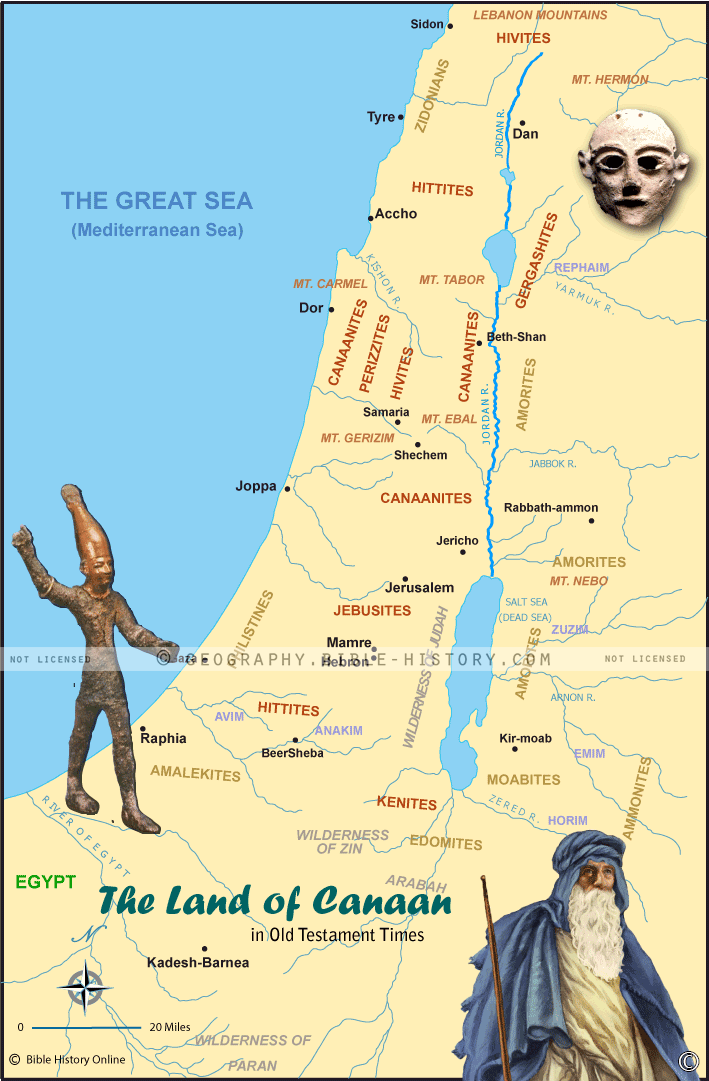 The Land of Canaan (Click image to be taken to photo source). Canaan During the Bronze Age (circa 3000–1200 BCE)Notably, archaeological evidence from the Bronze Age (circa 3000–1200 BCE) reveals that long before the Israelites arrived, Canaan was a thriving network of city-states, each with its own distinct identity. These independent city-kingdoms, such as Jericho, Megiddo, and Jerusalem (then Jebus), engaged in trade, diplomacy, and warfare. They were influenced by larger powers such as Egypt, which exercised political control over the region during the Late Bronze Age. This early history demonstrates that Canaan was never a unified land under a single ruler but rather a mosaic of cultures and peoples. It challenges the biblical narrative that frames the land solely as a divine inheritance for the Israelites, offering a more nuanced view of how land was contested and shared among many civilizations. In particular, the region of Canaan was inhabited by a mix of Semitic-speaking peoples, including the Canaanites, who lived in fortified city-states. These city-states were small, independent urban centers that controlled the surrounding rural areas. They were not part of a unified political entity but rather a network of independent city-kingdoms, which often interacted with one another through trade, diplomacy, and warfare. These city-states included important centers such as Jericho, Megiddo, Hazor, Gezer, Gaza, and Jerusalem (then known as Jebus). Each city-state was typically ruled by a king, who not only held political and military power but also played a significant role in religious life. Canaanite religion was polytheistic, and each city had its own patron deity, with temples dedicated to gods such as El, Baal, Astarte, and Asherah. The king was often seen as a semi-divine figure or a representative of the gods, and religious rituals were an essential part of city life. Egyptian Influence Over Canaan (1550–1200 BCE)For example, during the Late Bronze Age (circa 1550–1200 BCE), Canaan fell under the influence of the powerful New Kingdom of Egypt. Around 1550 BCE, during Egypt's New Kingdom period, Canaan became a vassal state of Egypt. Pharaohs stationed garrisons and appointed governors in Canaan to oversee the region. This made the Canaanite city-states economically and politically dependent on Egypt, though they retained a significant degree of cultural autonomy. Despite Egyptian dominance, Canaanite culture continued to thrive. The city-states maintained strong fortifications, developed advanced agricultural systems, and engaged in vibrant trade networks. Egyptian influence, while significant, did not erase Canaanite identity but rather led to a fusion of Egyptian and Canaanite practices, especially in areas such as religion, trade, and administration. The Canaanite city-states paid tribute to Egypt but continued to operate semi-independently, contributing to the region’s prosperity during this period.  New Kingdom of Egypt Map (click image to be taken to source) Canaan as a Crossroads of CivilizationsThe parallels between Canaan’s ancient political struggles and modern imperialism become clear when we recognize how external powers—be they Egyptian pharaohs or British colonialists—used Canaan’s strategic position to dominate the region. For example, Canaan’s location at the crossroads of powerful empires such as Egypt, Mesopotamia, and the Hittite Empire made it a key player in the international politics of the ancient Near East. The Canaanite city-states benefited from their position along major trade routes, which brought wealth and exposure to the cultures of neighboring regions. Canaanite merchants traded goods such as olive oil, wine, grain, and textiles, and in return, they imported luxury items from Egypt, Mesopotamia, and Anatolia. Thus, Canaan’s strategic importance made it a battleground for control by these larger powers. Egyptian control over Canaan was often contested by the Hittites to the north and the Assyrians and Babylonians to the east, as you can see on the map below. This resulted in a period of political instability but also cultural exchange, as Canaanite society absorbed elements from all of these civilizations. Notably, one of these absorbed elements may have been the modern-day Jewish God, which is termed Yahweh. Scholars suggest Yahweh likely originated as a local deity from the southern regions of Edom, Midian, or Seir. Indeed, some scholars argue that the Kenites or Midianites, nomadic groups who lived in the southern deserts, may have introduced Yahweh to the early Israelites. This is supported by some biblical texts that describe Yahweh as coming from the southern regions (e.g., Deuteronomy 33:2 and Judges 5:4). This deity was worshiped alongside Canaanite gods like El and Baal before gaining prominence in Israelite religion. In particular, earliest inscriptions mentioning Yahweh, such as the Mesha Stele (circa 840 BCE), indicate that Yahweh was initially one god among many in a broader polytheistic context, so in the early Israelite period, Yahweh was likely worshiped alongside other deities. Specifically, the Canaanite pantheon, which included gods like El, Baal, Astarte, and Asherah, was prominent, and many early Israelites may have participated in this religious system. Accordingly, Yahweh likely began as a tribal god who eventually gained prominence over other deities. Archaeological finds, such as household figurines of Asherah and other deities, suggest that Israelites practiced polytheism well into the Iron Age (1200–586 BCE). Over time, Yahweh began to be seen as the primary god of Israel, though this period is better characterized as monolatry—the worship of one god while acknowledging the existence of others—rather than monotheism. 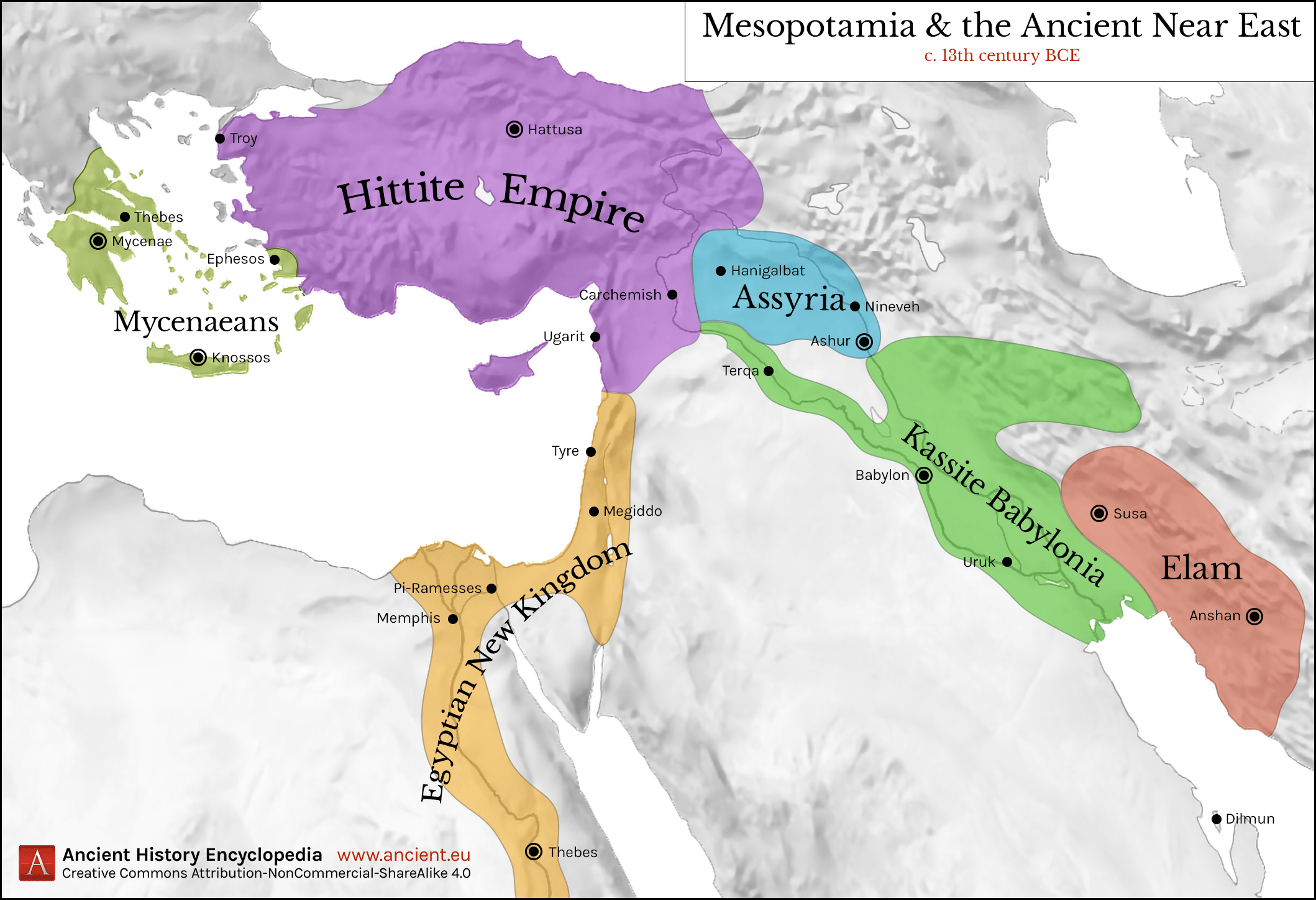 Ancient Mesopotamia World Map showing Egyptian New Kingdom in 13th century BCE and the empires surrounding it. (Click image to be taken to source). The Biblical NarrativeWho Are the Israelites & Why Were They Called Israelites?The biblical story of the Israelites’ time in Egypt and their eventual Exodus can be a bit confusing, especially when trying to reconcile it with historical context. So first, I will break it down and clarify what happened before the Israelites were enslaved, why they were called Israelites, and how the biblical narrative explains their mass departure from Egypt, even though they were not yet a kingdom. Accordingly, just as the biblical narrative positioned the Israelites as divinely entitled to Canaan, modern Zionism has drawn upon this religious framework to justify territorial claims. Yet, as evidenced in the following section, modern archaeological evidence of the shared history between Canaanites, Philistines, and Israelites complicates this narrative. The Biblical Story of the IsraelitesFirst, it is important to remember that the term "Israelites" refers to the descendants of Jacob- which is also known as Israel. In particular, the story of the Israelites begins with Abram (later called Abraham), a man living in Ur of the Chaldeans (Mesopotamia), whom God calls to leave his home and go to Canaan (modern-day Israel/Palestine). Here, God enters a covenant with Abram, promising him numerous descendants, the land of Canaan, and that his descendants will be God's chosen people. This covenant is central to the biblical narrative and becomes the foundation of Israel's identity. The story continues by stating how despite their old age and Sarah’s barrenness, God miraculously gives Abraham and his wife, Sarah, a son named Isaac, fulfilling part of the covenant promise (Genesis 21). After Abram’s (Abraham) death, the covenant promise continues through Isaac, who marries Rebekah and has twin sons, Esau and Jacob. Isaac’s story is less prominent, but he is depicted as a patriarch who continues Abraham’s legacy. The younger son, Jacob, becomes the central figure of the next generation. Despite his early deception (he tricks his brother Esau out of his birthright and blessing), Jacob receives the covenantal promise from God. Jacob has a vision of a ladder reaching to heaven (often called Jacob’s Ladder), where God reaffirms the covenant with him, promising that his descendants will inherit the land of Canaan (Genesis 28:10–15). Accordingly, after wrestling with an angel, Jacob is given the name Israel, meaning “he who struggles with God” (Genesis 32:28). This marks the beginning of the people of Israel as a family and nation. Indeed, the story continues and describes how Jacob has twelve sons through his two wives (Leah and Rachel) and their handmaidens. It is these twelve sons that became the heads of the twelve tribes of Israel, and thus who formed the core of the Israelite people- each tribe is named after one of Jacob’s sons, such as Judah, Levi, Reuben, and Joseph. Who Were the Israelites Before Egypt? Before they went to Egypt, these people were essentially a large, extended family or clan. They were semi-nomadic herders who moved around the land of Canaan (modern-day Israel/Palestine), settling in various places like Hebron and Beersheba. They weren’t a kingdom yet, nor did they have any centralized political organization at this point. Notable among them is Joseph, Jacob's favorite son, who is pivotal for the later Exodus narrative. Why Did the Israelites Go to Egypt? The Bible recounts how Joseph’s brothers sold him into slavery out of jealousy, and he was taken to Egypt (Genesis 37). They were jealous for two reasons, according to the Bible. First, Jacob (Israel), their father, clearly favored Joseph above all his other sons because he was the firstborn of his favorite wife, Rachel. This favoritism was symbolized when Jacob gave Joseph a special robe, often referred to as the "coat of many colors" (Genesis 37:3). The other brothers did not receive such gifts, which made them resent Joseph. Second, Joseph had two dreams that suggested he would one day rule over his brothers, and in both dreams, his brothers would bow down to him. Joseph did not keep these dreams to himself; instead, he told them to his brothers, which increased their jealousy and anger. For example, in the first dream, Joseph saw himself and his brothers binding sheaves of grain. Joseph’s sheaf stood upright, while his brothers' sheaves gathered around and bowed down to it (Genesis 37:5-7). In the second dream, Joseph saw the sun, the moon, and eleven stars bowing down to him (Genesis 37:9-10). This suggested that not only his brothers but also his father and mother would bow to him. Even Jacob rebuked him for this, though he kept the dream in mind. The main thing Joseph revealed to his family was his dreams that symbolized his future greatness and the subservience of his family members to him. These dreams foretold that he would hold a position of power and leadership. While Joseph seemed innocent in his sharing of the dreams, his brothers took it as arrogance, fueling their jealousy and leading to their betrayal. How Did His Brothers Betray Him? One day, Jacob sent Joseph to check on his brothers, who were tending their sheep near Shechem. When the brothers saw Joseph coming from a distance, they plotted to kill him (Genesis 37:18). Their initial plan was to throw him into a pit and claim that a wild animal had killed him. However, their oldest brother, Reuben, wanted to prevent them from killing Joseph. He suggested that they throw Joseph into a pit instead, intending to secretly rescue him later and return him to their father (Genesis 37:21-22). Thus, the brothers agreed with Reuben’s plan and stripped Joseph of his coat of many colors, a symbol of their father’s favoritism, and threw him into an empty cistern (a pit or well) without food or water (Genesis 37:23-24). But while Joseph was in the pit, the brothers noticed a caravan of Ishmaelite traders passing by on their way to Egypt. Judah, another brother, suggested they sell Joseph to the Ishmaelites instead of killing him, reasoning that there was no profit in murder (Genesis 37:26-27). The brothers sold Joseph for twenty pieces of silver, a common price for a slave at the time (Genesis 37:28). The Ishmaelite traders took Joseph to Egypt, where he would eventually be sold as a slave to Potiphar, a high-ranking Egyptian official. To cover up their betrayal, the brothers took Joseph’s coat, dipped it in the blood of a slaughtered goat, and brought it back to their father Jacob. They told Jacob that Joseph had been killed by a wild animal. Jacob, devastated by the sight of the blood-stained coat, believed their story and mourned deeply for his lost son (Genesis 37:31-35). Joseph's Rise from Slave to Power in Egypt After being sold to Ishmaelite traders, Joseph was sold again as a slave to Potiphar, an Egyptian official who was the captain of Pharaoh’s guard (Genesis 39:1). Potiphar recognized Joseph’s talents, and Joseph was placed in charge of managing Potiphar’s household. Unfortunately, Joseph’s fortunes took a turn when Potiphar’s wife falsely accused him of trying to seduce her. As a result, Joseph was thrown into prison (Genesis 39:19-20). Despite this, God continued to bless him, and the prison warden eventually put Joseph in charge of the other prisoners. While in prison, Joseph met two of Pharaoh’s servants—the chief cupbearer and the chief baker—who had been imprisoned for displeasing Pharaoh. Both men had troubling dreams, and Joseph correctly interpreted them (Genesis 40). The cupbearer’s dream predicted his restoration to Pharaoh’s court, and the baker’s dream predicted his execution. Two years later, Pharaoh himself had two dreams that none of his wise men could interpret. The cupbearer, remembering Joseph’s ability, told Pharaoh about him (Genesis 41:9-13). Joseph was summoned from prison to interpret Pharaoh’s dreams. He explained that the dreams predicted seven years of abundance, followed by seven years of famine in Egypt and the surrounding lands (Genesis 41:14-32). Impressed by Joseph’s wisdom, Pharaoh appointed him as second in command over all of Egypt, giving him the responsibility to manage the land and store up grain during the seven years of abundance to prepare for the coming famine (Genesis 41:38-41). Pharaoh gave Joseph a signet ring, symbolizing his authority, and made him the governor of Egypt, second only to Pharaoh himself. Joseph’s Provision for His Family: When the famine eventually struck, it affected not only Egypt but also Canaan, where Joseph’s family lived. This led to a reunion between Joseph and his brothers. During the famine, Jacob (Israel) sent his sons to Egypt to buy grain. They did not recognize Joseph, who was now dressed as an Egyptian official, but Joseph recognized them (Genesis 42:6-8). Joseph tested his brothers, eventually revealing his identity to them (Genesis 45:1-4). Joseph forgave his brothers for selling him into slavery, explaining that God had used their actions to fulfill His plan and save lives during the famine (Genesis 45:5-7). Joseph invited his entire family to come to Egypt so that he could provide for them during the remaining years of famine. Joseph arranged for his father Jacob (Israel) and all of his brothers and their families (about 70 people in total) to move to Egypt. Pharaoh welcomed them, offering them the fertile land of Goshen to live in (Genesis 47:5-6). Goshen was located in the northeastern part of Egypt, ideal for Jacob's family since they were herders, and this land provided good grazing for their livestock. Living Peacefully in Egypt Joseph’s family was able to settle and live peacefully in Egypt for several generations, thanks to Joseph’s high status and favor with Pharaoh. Joseph ensured that his family had everything they needed, giving them grain and supplies to survive the famine. The land of Goshen became their new home, and they thrived there under Joseph’s protection. The Israelites lived in peace and prospered in Goshen, and Joseph continued to serve as Pharaoh’s trusted governor. The famine eventually ended, and the Israelites continued to live in Egypt as a separate community with their own traditions and customs. Indeed, Joseph fully integrated into Egyptian society, marrying an Egyptian woman named Asenath (Genesis 41:45) and adopting Egyptian customs, yet he maintained his Hebrew identity and loyalty to God. He named his sons Manasseh and Ephraim, names that reflected his Hebrew heritage and his journey of suffering and success in Egypt (Genesis 41:51-52). Legacy of Joseph’s Settlement Joseph's settlement in Egypt set the stage for the future of the Israelites. Over the next few centuries, Joseph’s family grew and multiplied in Egypt, becoming a large population. This is crucial because it sets the stage for the later biblical narrative where the Israelites are enslaved by a new Pharaoh who "did not know Joseph" (Exodus 1:8). This leads to the story of the Exodus. In particular, the Bible explains that the Israelites multiplied and became numerous in Egypt, which worried the Pharaoh. He feared that they might ally with Egypt's enemies in case of war (Exodus 1:9-10). To prevent this perceived threat, the Egyptians enslaved the Israelites, forcing them into hard labor, building cities like Pithom and Rameses (Exodus 1:11). This is where the idea of the Israelites being slaves in Egypt comes from. Before his death, Jacob (Israel) blessed his sons, especially Joseph’s two sons, Manasseh and Ephraim, marking them as significant leaders in the future tribes of Israel (Genesis 48). Jacob’s death and burial in Canaan reinforced the connection of his descendants to the land promised by God to Abraham. Conclusion Joseph’s remarkable rise from slavery to a powerful position in Egypt is depicted as part of God’s providence, allowing him to save Egypt and his family from famine. By the time his family joined him in Egypt, Joseph had the power, resources, and favor to provide for them. The land of Goshen became their home, and the Israelites lived there peacefully for generations, growing in number and strength. Joseph’s leadership not only ensured the survival of his family but also laid the foundation for the later history of the Israelite nation, which would eventually lead to the Exodus. Who are the Ishmaelites & Why Were They Called Ishmaelites?Recall the story of Abraham and Sarah, his barren wife who had a miracle baby. However, before Sarah was able to give birth, Abraham had had another child with his Egyptian slave, Hagar. In the vast landscape of religious history, few stories hold the same depth of connection between multiple faiths as that of Ishmael, the first son of Abraham. His narrative, shared across Judaism, Christianity, and Islam, offers a unique glimpse into the origins of some of the world’s most significant religious identities. From his birth in the Hebrew Bible to his revered status in the Quran, Ishmael's life story shapes the cultural and spiritual foundations of the Israelites and the Arab peoples, bridging the histories of these three great faiths. The Birth of Ishmael: A Story of Tension and Divine Promise The tale of Ishmael begins with Abraham, a central figure in the Bible, whose deep faith in God would lead him to become the patriarch of many nations. However, before the miracle of Isaac—Abraham’s son with his wife Sarah—there was Hagar, Sarah’s Egyptian slave. When Sarah believed she could not have children, she gave Hagar to Abraham in the hopes that Hagar might bear a child in her place (Genesis 16). Hagar gave birth to Ishmael, Abraham’s firstborn son. But the joy of Ishmael’s birth quickly turned to tension. When Sarah eventually gave birth to her own son, Isaac, the rivalry between Sarah and Hagar, and later between their sons, became too much to bear. Sarah urged Abraham to send Hagar and Ishmael away, and though reluctant, Abraham followed God’s command, sending them into the wilderness. Yet, despite the separation, God promised Abraham that Ishmael would also become the father of a great nation (Genesis 21:18). Ishmael’s Descendants: The Ishmaelites The Ishmaelites, the descendants of Ishmael, are depicted in the Bible as nomadic desert dwellers. Living in the regions between Canaan, Egypt, and Arabia, the Ishmaelites led a life that revolved around the ancient trade routes. Genesis 37 tells the story of Joseph, Abraham’s great-grandson, who was sold by his jealous brothers to Ishmaelite traders. These traders were traveling from Gilead to Egypt, carrying spices, balm, and myrrh—a clear sign of their role in the regional economy. Beyond their nomadic lifestyle, the Ishmaelites were organized into twelve tribes, each led by one of Ishmael’s twelve sons (Genesis 25:12-16). These twelve tribes spread across a wide geographical area, from Egypt to Assyria, laying the foundations for what many historians consider the early Arab peoples. Ishmael’s sons—names like Nebaioth, Kedar, and Tema—echo throughout the ancient histories of these regions, marking the tribes that would play a key role in the trade and political dynamics of the Near East. Ishmael in Islam: Prophet and Ancestor of the Arabs While the story of Ishmael forms a crucial part of Judeo-Christian tradition, it takes on even greater significance in Islam. In Islamic tradition, Ishmael (known as Isma'il) is honored as a prophet and the forefather of the Arab peoples. He is particularly revered for his role in the Quraysh tribe, the tribe from which the Prophet Muhammad descended. According to Islamic teachings, Ishmael and his father Abraham worked together to rebuild the Kaaba in Mecca, the most sacred site in Islam. This act of devotion cemented Ishmael’s role not just as a prophet, but as a pivotal figure in the spiritual and cultural history of Arabia. The story of Ishmael in Islam reflects a continuation of Abraham’s covenant with God, but through Ishmael’s lineage, establishing the Arab peoples as integral to the monotheistic tradition. Shared Ancestry, Divergent Paths The shared ancestry of Isaac and Ishmael plays a critical role in the Abrahamic religions. In the Bible, Isaac’s descendants—the Israelites—are chosen to carry forth God’s covenant with Abraham, forming the nation of Israel. Meanwhile, Ishmael’s descendants—the Ishmaelites—branch off, developing a distinct identity as desert dwellers and traders, living in hostility toward their brothers (Genesis 25:18). In Islam, the story of Ishmael highlights a different path. Rather than being separated from God’s promise, Ishmael is seen as a prophet and a chosen son, through whom Abraham’s legacy continues in the Arab world. His life story connects the Arab peoples directly to Abraham, underscoring the unity of monotheistic worship and the shared reverence for one God (Allah). A Legacy That Transcends Faiths The story of Ishmael and his descendants speaks to the shared origins of Judaism, Christianity, and Islam. It illustrates how one family—the family of Abraham—gave rise to distinct and influential peoples whose legacies continue to shape the world today. Despite the tensions and divisions between Isaac and Ishmael, the promises made to both sons by God ensured that each would father great nations, setting the stage for their profound impact on religious and cultural history. At its core, Ishmael’s story is one of faith, divine promise, and the complexities of family—a tale that resonates across centuries and cultures, linking the Israelites and the Arabs to a common ancestor, yet leading them down different paths. Through this shared heritage, the legacy of Ishmael endures, serving as a reminder of the intertwined histories of the Abrahamic faiths and their ongoing influence on the world today. The Evidence For or Against The Biblical NarrativesThe Emergence of Early Israelites in Canaan (1500–1200 BCE)The Exodus narrative in the Hebrew Bible describes a miraculous escape of the Israelites from slavery in Egypt, followed by divine interventions like the Ten Plagues and the crossing of the Red Sea. This culminated in their arrival in Canaan, the Promised Land, traditionally dated to the 13th or 12th century BCE. However, as the Israelites rose to prominence in the region, the land of Canaan was not a blank slate. The Israelites were one of many peoples vying for control, their identity shaped by both their struggles with and absorption of Canaanite, Philistine, and Egyptian influences. The Bible tells the story of the Promised Land, but archaeological findings suggest that the Israelite kingdoms were one of many competing forces, far from the sole inheritors of Canaan’s legacy. Map of Canaan- The Promise Land  Canaan's boundaries were east of the Mediterranean Sea, south of modern-day Lebanon and Syria, and west of modern-day Jordan, with the Jordan River as the border. (Click image to be taken to source) Historical and Archaeological Evidence At this time of the purported Exodus, Canaan was a politically fragmented region, influenced by powerful empires like Egypt, Assyria, and Babylonia. Around 1200 BCE, the region experienced significant upheaval, with the collapse of several city-states due to a combination of internal unrest, invasions, and economic decline. This created a power vacuum that allowed new groups to establish themselves, including the Philistines, who settled along the southern coast, and the Israelites, who occupied the hill country of central Canaan. The traditional biblical account portrays the Israelites as a people who had lived in Egypt for several generations before being enslaved by the Pharaoh. Their liberation, under Moses, involved a series of miraculous events that led to their escape from Egypt, followed by 40 years of wandering in the desert before they entered Canaan. Upon their arrival, under the leadership of Joshua, they are said to have swiftly conquered the land, dividing it among the twelve tribes. However, archaeological evidence challenges this version of events. In an article, for The Jerusalem Post, Stephen Gabriel Rosenberg highlights the lack of direct archaeological evidence for the Exodus, such as mentions of Israelite enslavement or mass departure in Egyptian records, which raises questions about the historical accuracy of the biblical narrative. The Setting: Egypt and Canaan (13th Century BCE) During the reign of Ramesses II (1279–1213 BCE), often linked with the traditional dating of the Exodus, Egypt's control over Canaan was strong. Egyptian records from this period document the New Kingdom's dominance over Canaan, with Canaanite city-states functioning as vassals, paying tribute to Egypt and governed through local rulers and Egyptian officials. In contrast to the biblical narrative, there is no direct Egyptian record of the Israelites' enslavement or a mass exodus from Egypt. Despite extensive Egyptian records from this period, there is no mention of the Israelites’ enslavement or exodus. Modern technologies and archaeological searches for evidence of a mass Israelite migration through the Sinai Peninsula also have not yielded conclusive results. Merneptah Stele (circa 1208 BCE) The Merneptah Stele, erected by Pharaoh Merneptah (r. 1213–1203 BCE), is one of the most significant pieces of evidence regarding the early Israelites. The stele, discovered in Thebes in 1896, commemorates Merneptah's military victories over various groups in Canaan. It contains the earliest known extra-biblical reference to "Israel," stating, “Israel is laid waste, his seed is no more.” This suggests that by 1208 BCE, a group called Israel existed in Canaan, though not as a kingdom but as a tribe distinct from the Canaanite city-states like Ashkelon and Gezer. Israelite Emergence from Canaanite Society Contrary to the biblical depiction of a foreign group conquering Canaan, archaeological evidence suggests that the Israelites emerged from within the Canaanite population during the Late Bronze Age (circa 1200 BCE). The early Israelites likely began as semi-nomadic people who gradually settled in rural highland communities, distinct from the lowland Canaanite city-states. The history of the Israelites also intertwines with that of the Philistines, who settled along the southern coast of Canaan around the same time. Archaeological evidence shows that early Israelite settlements shared cultural traits with their Canaanite neighbors, including pottery styles and agricultural practices. Gradual Differentiation and Identity Formation The biblical account of a sudden conquest of Canaan, as described in the Book of Joshua, contrasts with the Book of Judges, which presents a more fragmented and gradual process of settlement and conflict with the existing Canaanite city-states. Moreover, archaeological record supports the latter view, showing evidence of peaceful infiltration rather than a widespread, violent conquest. Over time, the early Israelites began to develop a separate identity, primarily distinguished by their emerging monotheistic worship of Yahweh, which set them apart from the polytheistic practices of their Canaanite neighbors, who worshipped deities such as El, Baal, Astarte, and Asherah. Thus, this process of identity formation was gradual and marked by cultural interaction, rather than isolation. The Role of the Exodus Story While the Exodus narrative lacks substantial archaeological evidence to support a literal mass migration and conquest, it likely developed as a national origin myth. Such myths are common in the formation of collective identities, serving to unify a people and provide a shared sense of purpose, history, and divine favor.The Exodus story may have been retrospectively created or embellished to emphasize the Israelites' unique relationship with Yahweh and their divinely ordained right to the land of Canaan. By the Iron Age, the Israelites established the Kingdoms of Israel and Judah, while the Philistines controlled the coastal regions, including Gaza. The evolution of Canaan into the modern territories of Israel and Gaza reflects centuries of political change, conquests, and shifting borders. This early history demonstrates that Canaan was never a unified land under a single ruler but rather a mosaic of cultures and peoples. It challenges the biblical narrative that frames the land solely as a divine inheritance for the Israelites, offering a more nuanced view of how land was contested and shared among many civilizations. This historical reality raises questions about the exclusivity of Israel’s modern claims to the land. Just as the Israelites did not exist in isolation from the Canaanites and other peoples, modern Israel’s territorial claims are deeply entwined with the Palestinian people’s centuries-long presence in the same land. Here, we begin to see the roots of a contested history—one where no single narrative can easily account for the region’s diverse past. Modern Day Gaza 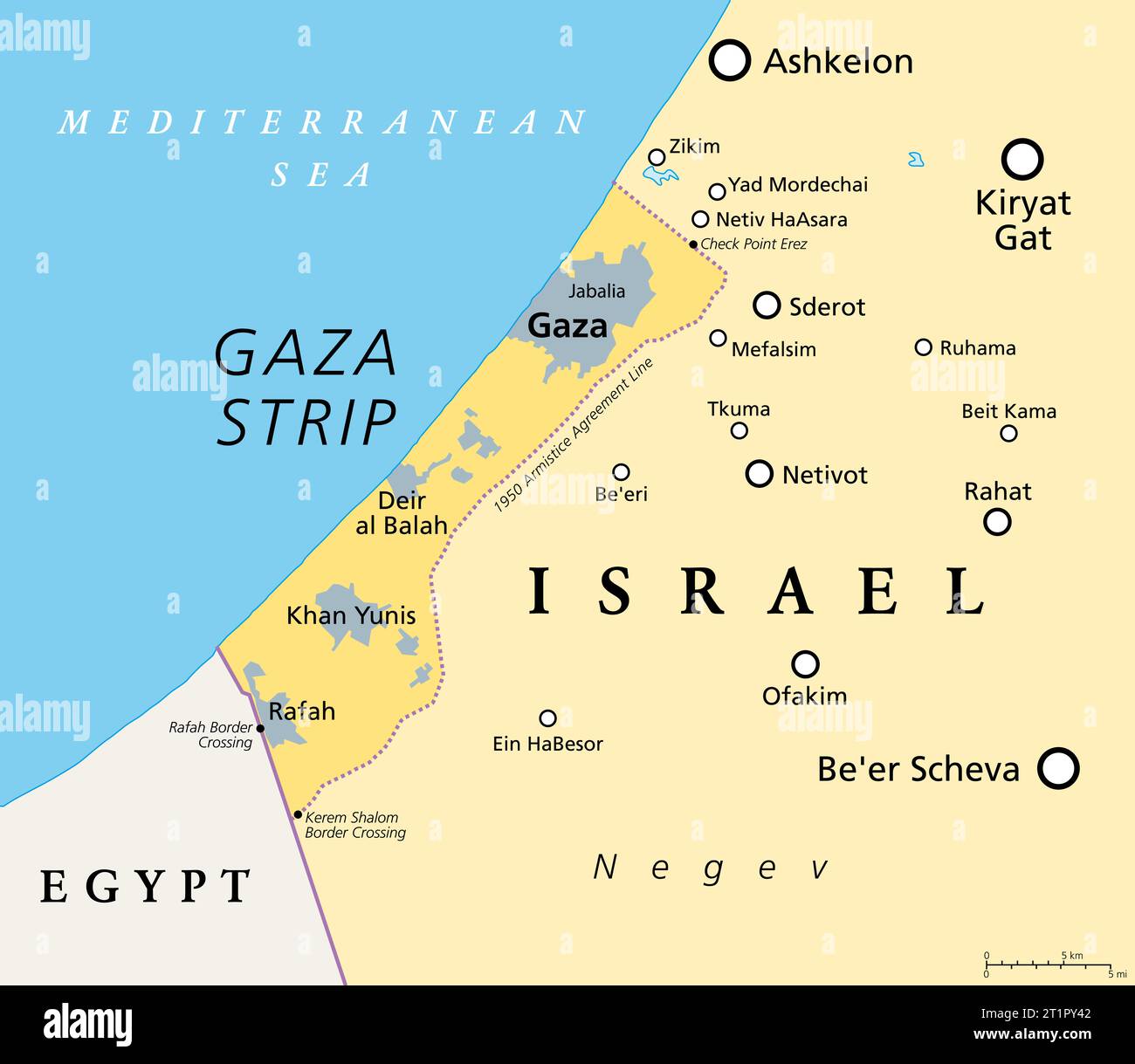 (Click image to be taken to source) The History of Palestine & GazaThe name "Palestine" derives from the Philistines. The Arrival of the Philistines (circa 1200 BCE)The Philistines were a group of people who settled along the southern coastal plain of Canaan (modern-day Israel and Gaza) around the 12th century BCE, during the Late Bronze Age (see map below). They are commonly identified as one of the "Sea Peoples," a coalition of seafaring tribes who migrated from the Aegean region or possibly Cyprus and Anatolia, due to upheavals in their homelands. They formed a Pentapolis—a confederation of five cities: Gaza, Ashkelon, Ashdod, Ekron, and Gath. Consequently, the name "Palestine" derives from the Philistines. Notably, the Philistines were technologically advanced, particularly in ironworking, which gave them a military edge over their neighbors, including the Israelites, who were still using bronze weapons. This technological advantage, combined with their fortified cities and organized military, made them formidable rivals. Gaza, in particular, was a key center for the Philistines, largely due to its strategic location as a coastal city with access to trade routes and its proximity to Egypt. Map of Philistia 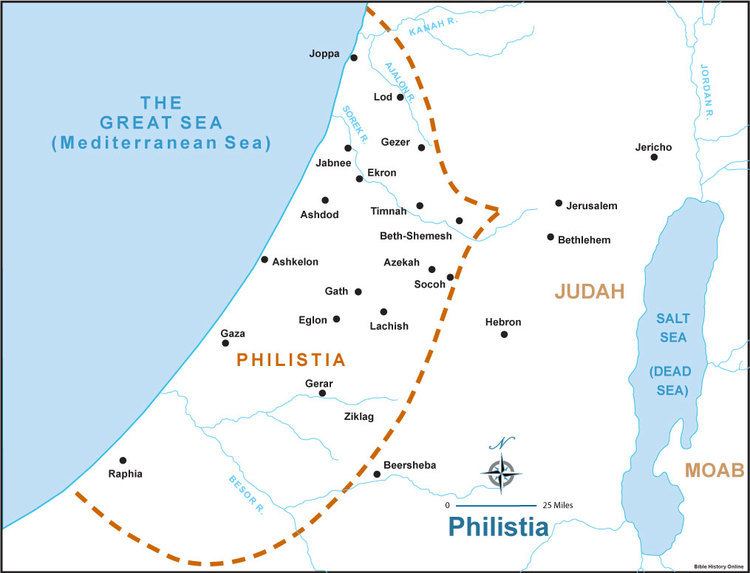 (Click image to be taken to source). Origins of the Philistines: The Sea Peoples The Sea Peoples were a confederation of naval raiders who targeted the Mediterranean coastal regions between c. 1276-1178 BCE, focusing heavily on Egypt. Furthermore, outside of Egypt, the Sea Peoples also assaulted the Hittite Empire, the Levant, and other Mediterranean coastal areas. They are considered one of the major contributing factors to the collapse of the Bronze Age (c. 1250–1150 BCE) and were once thought to be the primary cause of it. Despite their significance, their nationality and identity of the Sea Peoples remain a mystery, as the available records, mostly Egyptian, describe them only in the context of battle. For example, the Stele at Tanis states, “They came from the sea in their warships and none could stand against them.” This description typifies Egyptian references to these mysterious invaders. Consequently, scholars have proposed various theories about their origins, suggesting links to the Etruscans, Trojans, Italians, Philistines, Mycenaeans, and Minoans. However, no conclusive evidence supports these theories, and the origin of the Sea Peoples remains speculative. Despite this, although the the exact origins, composition, and motivations of the Sea Peoples remain a subject of debate, they are generally believed to have come from regions around the Aegean Sea and possibly from Anatolia (modern Turkey) or southern Europe. Historical Context: Late Bronze Age Crisis The Sea Peoples emerged during a period of widespread upheaval across the eastern Mediterranean, known as the Late Bronze Age collapse (circa 1200 BCE). This era saw the sudden downfall of many long-established civilizations, characterized by widespread destruction of cities, loss of trade routes, and a decline in central authority. Several factors likely contributed to this crisis, including:
It was within this context of instability that the Sea Peoples became a significant force, moving along the coasts of the eastern Mediterranean, raiding and sometimes settling in the lands they attacked. Thus, the invasions and migrations of the Sea Peoples coincided with the broader Late Bronze Age collapse, during which major civilizations, including the Mycenaean Greeks, the Hittite Empire, and several Canaanite cities, were either weakened or destroyed. While the Sea Peoples were not solely responsible for this collapse, their movements contributed to the instability of the region during this period. Philistines in Egyptian Records- Conflicts with Egypt The term "Sea Peoples" comes from Egyptian records, particularly from the reigns of Pharaohs Merneptah (r. 1213–1203 BCE) and Ramses III (r. 1186–1155 BCE), who documented battles with these groups. The Egyptians referred to them collectively as "Peoples of the Sea," but the exact identity of the various groups is less certain. Indeed, the term "Sea Peoples" is modern, first coined by French Egyptologist Gaston Maspero in c. 1881 CE, based on ancient Egyptian records that referred to these tribes as coming "from the sea" or "the islands." No ancient source names the coalition as "Sea Peoples." Scholars believe that the Sea Peoples were not a single ethnic group but rather a collection of different tribes or peoples united by shared interests in migration or conquest. Some of the names of Sea Peoples mentioned in Egyptian inscriptions include:
The Peleset, or Philistines, are the most well-known group, as they later became a significant political entity in the region of Canaan and are frequently mentioned in the Bible, and these are the ones who established the five key city-states (the Pentapolis). These pharaohs, Merneptah (r. 1213–1203 BCE) and Ramses III (r. 1186–1155 BCE), are also most noted for their conflicts with the Sea Peoples. Each claimed significant victories over them, and their inscriptions are the most detailed accounts of these events. Egyptian Pharaohs & their Conflicts with the Sea PeoplesThe Sea Peoples feature prominently in the reigns of several important Egyptian pharaohs:
In summary, the Sea Peoples were a collection of various groups who disrupted the political and social order of the eastern Mediterranean during the Late Bronze Age. Egyptian pharaohs like Ramesses II, Merneptah, and Ramesses III recorded their battles against these peoples, especially in the 13th and 12th centuries BCE. The Philistines (Peleset) emerged as one of the most prominent groups within the Sea Peoples, eventually settling in Canaan and becoming key players in the region’s political dynamics. The term "Sea Peoples," while modern, captures the complex reality of these maritime and migratory groups who helped shape the ancient Near East during a period of profound change. Conflict Between the Philistines & IsraelitesAfter their defeat by Ramesses III, some of the Sea Peoples, most notably the Philistines, settled permanently along the coast of Canaan. This settlement is reflected in later biblical and archaeological records. The Philistines became a major power in the region, establishing their city-states and clashing with the emerging Israelite kingdoms throughout the Iron Age. The Philistines are frequently depicted as adversaries and arch nemesis of the Israelites in the Bible, especially during the period of the Judges and the early Israelite monarchy (1200–1000 BCE). Their military superiority, largely due to their use of iron weapons, led to numerous conflicts with the Israelites. Famous biblical stories, such as Samson’s struggle with the Philistines and David’s defeat of the Philistine champion Goliath, highlight this rivalry. In addition to military conflict, the two groups were divided by deep cultural and religious differences. The Philistines were polytheistic, worshiping gods such as Dagon, Baal-Zebub, and Astarte. In contrast, the Israelites were monotheistic, worshiping Yahweh. Archaeological excavations in Philistine cities like Ashdod have uncovered temples dedicated to Dagon, underscoring the religious divide between the two peoples. Archaeological Evidence of the Philistines Archaeological excavations have corroborated many elements of the biblical narrative about the Philistines. Findings in cities such as Ashkelon, Ashdod, and Ekron reveal a rich material culture, with pottery that closely resembles Mycenaean ceramics, supporting the theory that the Philistines had Aegean origins. The Philistine cities were also well-fortified, with evidence pointing to advanced urban planning and extensive trade networks.  Out of the five key cities of the ancient Philistine pentapolis, Gaza is the only one that is not part of the modern state of Israel. The other four Philistine cities—Ashkelon, Ashdod, Ekron, and Gath—are located within Israel's borders today. (Click image to be taken to image source). Assyrian Domination and Decline (8th Century BCE)As evidenced, the Philistines, as an influential and enigmatic group in the ancient Near East, played a significant role in the history of the region, particularly along the coastal areas of Canaan (modern-day Israel and Gaza). Their history, however, is marked by a gradual decline as they faced successive waves of conquest by larger empires. By the 8th century BCE, the Neo-Assyrian Empire (911–609 BCE) dominated the ancient Near East, with its kings, notably Tiglath-Pileser III (r. 745–727 BCE), Shalmaneser V (r. 727–722 BCE), Sargon II (r. 722–705 BCE), and Sennacherib (r. 705–681 BCE), expanding the empire's influence into the Levant, including Palestine. Assyrian control over Palestine was achieved not through a single conquest but via multiple military campaigns designed to subdue local kingdoms and force them into tributary relationships. The region was strategically important due to its position along key trade routes connecting Mesopotamia to Egypt and the Mediterranean. Tiglath-Pileser III’s Campaigns Under Tiglath-Pileser III, Assyria adopted a policy of aggressive expansion. His reign marked the beginning of Assyria’s direct involvement in Levantine politics:
The Fall of Israel and Sargon II’s Campaigns The Kingdom of Israel remained unstable under Assyrian rule. In 722 BCE, after King Hoshea attempted to rebel by forming an alliance with Egypt, Assyria invaded under Shalmaneser V and Sargon II, decisively ending Israel’s independence. The Assyrians captured Samaria, Israel's capital, and destroyed the northern kingdom. This event initiated the Assyrian exile of the Israelites, with much of the northern kingdom's population deported and resettled in other parts of the empire. This policy of population transfer aimed to weaken rebellious regions by displacing local elites and dispersing populations. The fall of Israel and the subsequent deportations contributed to the legend of the Ten Lost Tribes of Israel. The region formerly controlled by Israel was reorganized into an Assyrian province, governed by Assyrian officials. Under Assyrian domination, the Philistines began to lose much of their political autonomy. While they were allowed to continue their local governance, they were subject to Assyrian oversight. Assyrian records, such as those from Sennacherib's campaigns, describe sieges against Philistine cities, which were often punished for rebellion. For example, Ashdod was sacked in 712 BCE after an uprising against Assyrian rule. Although the Philistines maintained their distinct identity to some degree, they began adopting elements of Canaanite and Assyrian customs. This cultural blending eroded their unique characteristics as a separate people. Their cities became integrated into the broader trade networks of the Assyrian Empire, and their strategic coastal locations made them important centers for commerce and interaction with other regions, including Egypt and the Israelite kingdoms. Subjugation by the Babylonians (6th Century BCE)Following the fall of the Neo-Assyrian Empire, the Neo-Babylonian Empire (626–539 BCE) rose to prominence under Nebuchadnezzar II. The Babylonians, known for their conquest of Judah and the destruction of Jerusalem in 586 BCE, also subjugated the Philistine cities. By this time, the Philistines had lost much of their former power, and their cities were further weakened by repeated conflicts and changing allegiances between the regional powers. The Babylonian conquest did not entirely eradicate Philistine culture, but it further diminished their political influence. As with the Assyrians, the Babylonians imposed heavy tribute and military oversight on the region. Nebuchadnezzar’s military campaigns against rebellious cities—including Ashkelon, which was destroyed in 604 BCE—further reduced the autonomy of the Philistines. Babylonian domination cemented the integration of the Philistine cities into larger imperial frameworks, and by the end of the 6th century BCE, the Philistine identity was largely subsumed by these broader powers. Persian Rule and Cultural Assimilation (539 BCE – 332 BCE) The Persian Empire under Cyrus the Great conquered Babylon in 539 BCE, marking the beginning of Persian rule over the Levant. Under Persian administration, the region was reorganized into satrapies (provinces), and the Philistine cities were included in the larger administrative structure of Abar Nahara (“Beyond the River,” the region west of the Euphrates). The Persians practiced a relatively tolerant form of governance, allowing local customs and religions to continue as long as tribute was paid and loyalty to the empire was maintained. However, by this time, the Philistines were no longer a dominant or distinct cultural group. Under Persian rule, they assimilated further into the larger regional population, adopting more Canaanite, Persian, and later Hellenistic influences. The Philistine cities became important ports and trade hubs within the Persian Empire, but their identity as a people distinct from their neighbors gradually disappeared. By the time of Alexander the Great’s conquest of the region in the 4th century BCE, the Philistines as a recognizable ethnic group had essentially vanished from the historical record. Philistine Integration into Regional Power Dynamics Throughout their history, the Philistines were deeply intertwined with the broader power struggles of the ancient Near East, and they frequently interacted with neighboring powers, including Egypt, Israel, and the great empires of Assyria, Babylon, and Persia. Egypt: The Philistines had a complex relationship with Egypt, sometimes serving as allies and other times as enemies. The Egyptians sought to control the southern Levant as a buffer zone against northern threats, and the Philistine cities, especially Gaza, were key to controlling trade routes between Asia and Africa. The Philistines are mentioned in Egyptian records, including those from the reign of Ramses III (who described conflicts with the "Sea Peoples," of which the Philistines were a part). Israel: The Philistines’ long-standing rivalry with the Israelites, particularly during the time of the united monarchy of Saul, David, and Solomon (10th century BCE), is well-documented in biblical texts. This rivalry was primarily over territory and control of key strategic areas. The battle between David and Goliath is one of the most famous stories from this period, symbolizing the larger struggle between the Israelites and Philistines. Assyria and Babylon: As noted, the Philistine cities often found themselves caught between larger empires, forced to pay tribute and ally with either Assyria or Egypt depending on the political landscape. This lack of autonomy gradually weakened their political power. The Legacy of the Philistines and Modern-Day GazaBy the Hellenistic and Roman periods, the Philistines as a distinct people had effectively disappeared from the historical stage. Their cities, particularly Gaza, continued to thrive under new rulers, but their cultural identity was absorbed into the larger tapestry of Canaanite, Egyptian, Assyrian, and later Greek and Roman civilizations. The name Palestine, which the Romans later applied to the entire region in the 2nd century CE, is a lasting reminder of the ancient Philistines, though the modern population of the Gaza Strip bears no direct ethnic or cultural connection to them. While the Philistines as a people ceased to exist, the geographic location of Gaza continued to be a contested and important territory throughout history. As a key port and trade city, Gaza was central to Philistine power and remains important in modern geopolitics. Its strategic location at the crossroads of Africa and Asia made it a contested territory throughout history, and it continues to play a pivotal role in the Israel-Palestine conflict today. The ancient rivalry between the Israelites and Philistines has a symbolic resonance with contemporary struggles over territory and identity in this region. In modern times, Gaza is a part of the Palestinian territories, and its population is predominantly Arab, with no direct ethnic or cultural lineage to the Philistines, who vanished from history over 2,500 years ago. However, the name “Palestine” itself is thought to have derived from “Philistia,” the land of the Philistines, and was used by the Romans after suppressing a Jewish revolt in 135 CE to rename the province of Judea to Syria Palaestina. Of the five cities in the Philistine Pentapolis, only Gaza is located within the modern Gaza Strip, while the other four cities--Ashkelon, Ashdod, Ekron, and Gath—are situated within the present-day borders of Israel. This geographic distinction reflects the broader historical significance of Gaza, which has maintained its identity as a distinct and significant urban center through successive conquests and into modern times. Ultimately, today, while the Philistines are often remembered for their conflicts with ancient Israel, their legacy is more broadly tied to the broader history of migration, conquest, and cultural integration in the eastern Mediterranean, a region that has long been a crossroads of civilizations. Neo-Assyrian Empire Territory Expansion from 823 BCE to 671 BCE  (Click image to be taken to source) Neo-Assyrian Empire Territory Claims (til approx. 650 BCE) Compared to the Babylonian Empire by 562 BCE 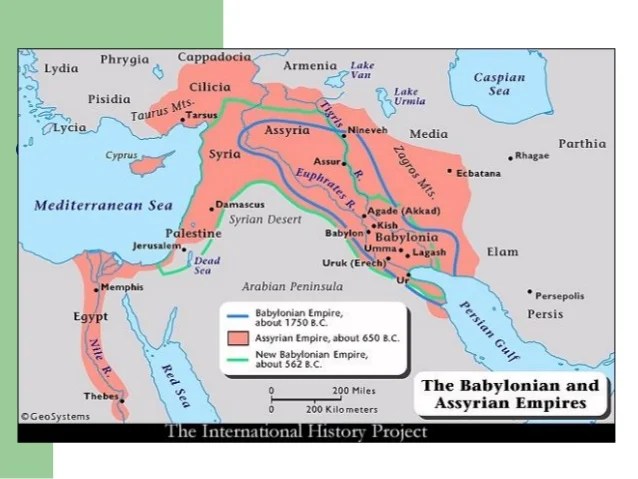 (Click image to be taken to source) Why Do Some Believe The Jewish Have a Connection to Modern-Day Israel?The Formation of the Kingdom of Israel and Judah (circa 1000 BCE)As the Israelites established themselves in Canaan, they transitioned from a tribal confederation to a unified monarchy around 1000 BCE, under the leadership of King Saul, David, and Solomon. This shift toward centralized leadership was driven by the need to defend against external enemies, especially the Philistines, who posed a significant threat. The people called for a monarchy to unite the tribes and strengthen military and political organization—a pattern mirrored in other ancient Near Eastern societies that faced similar pressures. King Saul (circa 1050 – 1010 BCE) was appointed as the first king by the prophet Samuel to unify the tribes and lead the Israelites against the Philistines. His kingship marked the transition from a tribal confederation to a centralized monarchy. However, Saul struggled to fully consolidate power and faced internal dissent. His reign ended tragically after a military defeat by the Philistines at the Battle of Mount Gilboa, where he took his own life (1 Samuel 31). Saul’s reign was short-lived, and he was succeeded by David (circa 1010 – 970 BCE). King David, initially a servant of Saul, ascended to the throne after Saul's death. He established Jerusalem as the political and spiritual capital of Israel, capturing the city from the Jebusites. David is credited with expanding Israel’s territory through successful military campaigns and securing Israel’s borders. He also initiated the centralization of Yahweh worship by bringing the Ark of the Covenant to Jerusalem. David's reign, though marked by military success, was also marred by internal conflicts, including a rebellion led by his son, Absalom. David’s other son, King Solomon (circa 970 – 930 BCE), claimed the throne, and during his reign, he further strengthened the kingdom by constructing the First Temple in Jerusalem, solidifying the city’s role as the religious center of the Israelites. King Solomon also pursued economic expansion through international trade and strategic alliances, often sealed by marriages to foreign rulers. His reign was characterized by economic prosperity and diplomacy. He established trade routes, married foreign princesses (including an alliance with Egypt), and undertook building projects throughout the kingdom. However, Solomon’s policies of high taxation and the use of forced labor led to discontent among the Israelite tribes. His foreign marriages introduced idolatrous practices, which the biblical narrative condemns. On the other hand, it is also important to note that while the biblical accounts depict the unified kingdom as vast and powerful, archaeological evidence suggests that its scale may have been smaller than described. Jerusalem shows signs of development during this period, but the grandeur of Saul, David, and Solomon's reigns may have been exaggerated or symbolic. Some scholars propose that, if a united monarchy existed, it was likely a modest tribal kingdom centered around Jerusalem with limited territorial reach. Map of Ancient Palestine (Bronze Age to Iron Age)  Map of the Levant circa 830 BCE. Click photo to be taken to source The Division of the Kingdom (circa 930 BCE) After Solomon's death, the kingdom fractured into two: Israel in the north and Judah in the south, with Jerusalem remaining the capital of Judah.
The division of the kingdom into Israel and Judah was likely driven by both economic and political factors. The northern tribes, which had access to more fertile lands and greater economic resources, may have resented the dominance of Jerusalem and the economic policies that favored the southern kingdom. In contrast, Judah, with its more isolated position, relied heavily on the Temple and religious legitimacy for its political power. Despite this, Jerusalem’s emergence as the religious and political heart of the Israelite kingdom, particularly after the construction of the Temple, solidified the centrality of Yahweh in Israelite worship. The monarchy under David and Solomon played a crucial role in elevating Yahweh as the chief deity of Israel, aligning religious and political authority. The promotion of Yahweh as the sole God was likely a means to unify the diverse Israelite tribes under a common religious framework, reinforcing the monarchy’s power. In this sense, the Hebrew Bible not only serves as a religious text but also as a tool for forging a collective Israelite identity, emphasizing their shared history, covenant with God, and connection to the land of Canaan. This parallels the role the Qur'an played in uniting the tribes of Arabia, helping to create a collective identity during a time of political and social fragmentation. Thus, the transition to monarchy, the rise of Jerusalem, and the centralization of Yahweh worship all contributed to the shaping of early Israelite identity, with the religious and political landscape intertwined in ways that reflected broader patterns seen across the ancient Near East.  Around 900 BC, the kingdom of Israel split between the North and the South. The North was called Israel and the South was called Judah. (Click image to be taken to source) Politics and the Role of Scripture in Unification The Fall of Israel (722 BCE) and Judah (586 BCE)The Fall of the Northern Kingdom of Israel (722 BCE) The Kingdom of Israel lasted for about 200 years but was politically unstable, with frequent changes in leadership. It often strayed from the religious practices centered around worshiping Yahweh. Eventually, the northern kingdom allied with other regional powers but was overrun by the Assyrian Empire. In 722 BCE, King Sargon II of Assyria conquered the Northern Kingdom, destroying its capital, Samaria. Many Israelites were deported and assimilated into other parts of the Assyrian Empire. These people are often referred to as the "Lost Ten Tribes of Israel." The Survival and Fall of the Southern Kingdom of Judah (586 BCE) While the Northern Kingdom of Israel was destroyed, the Southern Kingdom of Judah managed to survive for another 130 years. Though Judah faced pressure from both Assyria and Babylon, it maintained independence through tribute payments and alliances. Kings like Hezekiah and Josiah are notable for their religious reforms, centralizing worship in Jerusalem and eliminating other gods. However, the Babylonian Empire, under Nebuchadnezzar II, posed a growing threat. In 597 BCE, Babylon attacked Judah and captured Jerusalem. After another rebellion, the Babylonians returned in 586 BCE, destroying the city and Solomon’s Temple. Many Judeans were exiled to Babylon, marking the start of the Babylonian Exile. Notably, the destruction of the First Temple and the city of Jerusalem was a traumatic event for the Jewish people, both politically and spiritually. The Babylonian Exile marked the end of the Kingdom of Judah and the Jewish political presence in the region for many years. The Babylonian Exile (586 – 538 BCE)During the Babylonian Exile, many Jews lived in Babylon, where Jewish religious thought developed in the absence of the Temple. The Hebrew Bible began to be compiled and edited, and synagogues emerged as places of worship and study. Prophets such as Jeremiah and Ezekiel spoke of divine judgment for Israel’s sins, but also of future restoration, promising that God would not abandon His people. Return From Exile & Reconstruction: The Persian Period (539–332 BCE)In 539 BCE, the Persian Empire, under Cyrus the Great, conquered Babylon. In 538 BCE, Cyrus issued the Cyrus Decree, allowing the Jews to return to their homeland and rebuild the Temple in Jerusalem. The Second Temple was completed in 516 BCE, marking the beginning of the Second Temple Period. However, this period of return did not lead to a complete restoration of the Jewish kingdom. Judah became a province within the Persian Empire, and Jewish leaders focused on rebuilding the Temple and restoring religious practices rather than establishing a sovereign state. Ezra and Nehemiah were pivotal figures during this time, leading significant social and religious reforms that emphasized strict adherence to the Torah. They reestablished Jerusalem as the religious and cultural center of Jewish life. Under their guidance, Judah became a theocratic state under Persian rule, with priests and scribes assuming prominent leadership roles. Map of the Persian Empire during Cyrus the Great  (Click image to be taken to source) Hellenistic Influence & the Hasmonean Period (333–63 BCE)In 333 BCE, Alexander the Great, the young Macedonian king, launched a series of military campaigns that culminated in the defeat of the Persian Empire, which had controlled Judea since 539 BCE. As a result, Judea, along with much of the eastern Mediterranean, came under Hellenistic influence, marking the beginning of the Hellenistic period in Jewish history. As part of Alexander's broader vision, Hellenistic (Greek) culture, language, and institutions began to spread throughout the conquered regions, including Judea. Greek became the lingua franca, and many cities adopted Greek customs, governance, and architecture. While some Jews embraced Hellenism, others resisted it, viewing it as a threat to their religious traditions and identity. This tension would eventually play a significant role in subsequent political and religious conflicts in the region.  The historical record of the Maccabees, who were a traditional Jewish family who resisted the cultural & political dominion of the Greeks post- Alexander the Great’s empire expansion, when it included Turkey, Egypt, the Middle East (including Judea), and the East up to India. (Click image to be taken to source) Alexander’s Death and the Division of the Empire In 323 BCE, Alexander the Great died suddenly, and his vast empire was divided among his generals, known as the Diadochi. This led to the formation of several Hellenistic kingdoms, two of which had a direct impact on Judea:
Eventually, the Seleucids wrested control of Judea from the Ptolemies, and around 200 BCE, Israel came under the control of Antiochus III, the Seleucid King Of Syria. Initially, the Jewish population maintained relative autonomy, and were allowed to practice their religion freely, but this changed under Antiochus IV Epiphanes, his son, who attempted to forcefully Hellenize the Jewish population. Division of Judea into Hellenistic Kingdoms This was due to the Seleucid Empire and Ptolemaic Empire  (Click image to be taken to source) The Conflict with the Seleucids and Religious Suppression By the mid-2nd century BCE, the Seleucid kings, particularly Antiochus IV Epiphanes (r. 175–164 BCE), took a more aggressive approach toward Hellenization, which included interfering with Jewish religious practices. Antiochus banned Jewish religious practices, desecrated the Second Temple in Jerusalem by installing a statue of Zeus, and outlawed circumcision, Sabbath observance, and Torah study. For many Jews, these acts were not only political but also deeply offensive to their religious beliefs and traditions, and it was these oppressive actions sparked the Maccabean Revolt (167–160 BCE), led by a Jewish priest named Mattathias and his sons, most notably Judah Maccabee. The revolt aimed to reclaim Jewish religious freedom and expel Seleucid forces from Judea. The Maccabean Revolt and Hasmonean Kingdom (167 BCE – 63 BCE)167 BCE: The Maccabean Revolt The Maccabean Revolt stands as one of the most significant moments in Jewish history—a time when a small, determined group of Jews rose against the might of the Seleucid Empire. This revolt was not just a reaction to foreign rule but a fierce defense of religious and cultural identity, sparked by the oppressive policies of the Seleucid king, Antiochus IV Epiphanes. In particular, the revolt was initially a response to Antiochus' desecration of the Jerusalem Temple and the suppression of Jewish religious practices. Specifically, in 167 BCE, these mounting pressures reached a breaking point. In the town of Modiin, a local Jewish priest named Mattathias sparked the rebellion by refusing to perform a Hellenistic sacrifice, an act that was followed by the killing of a Seleucid official. Mattathias and his five sons fled to the wilderness, gathering supporters who were committed to the defense of Jewish law and tradition. After Mattathias's death, his son Judah Maccabee—also known as Judah the Hammer—took up leadership of the rebellion. Despite being vastly outnumbered and poorly equipped compared to the powerful Seleucid army, the Maccabees employed guerrilla warfare tactics and rallied widespread support among Jews who were fiercely opposed to the Hellenistic policies. Judah Maccabee proved to be an exceptional leader, using his deep knowledge of the terrain and an unshakable belief in the righteousness of their cause to strike strategic blows against the Seleucid forces. The Miracle of Hanukkah (164 BCE) In 164 BCE, the Maccabees recaptured Jerusalem and, most importantly, reclaimed the Second Temple, which had been defiled by the Seleucids. In an act that would become central to Jewish tradition, the Maccabees cleansed the Temple of Greek idols and rededicated it to the worship of Yahweh. One of the most enduring aspects of this victory is the miracle of Hanukkah. According to Jewish tradition, when the Maccabees relit the menorah (the Temple's eternal flame), there was only enough consecrated oil to last for one day. Miraculously, the oil burned for eight days—long enough for new oil to be prepared. This event is commemorated by the festival of Hanukkah, which celebrates both the military victory and the spiritual triumph of the Jewish people. The Hasmonean Kingdom (140 BCE – 63 BCE) The Hasmonean Kingdom (140 BCE – 63 BCE) was established following the successful Maccabean revolt against the Seleucid Empire. What began as a movement to restore Jewish religious freedom soon transformed into a political dynasty. The Hasmoneans, originally guerrilla fighters, evolved into rulers of a semi-autonomous Jewish state under Seleucid suzerainty. Simon Maccabee, brother of Judah Maccabee, played a pivotal role in solidifying Hasmonean power, taking the title of high priest and declaring himself ruler, thus laying the foundation for a new era of Jewish governance. Under Simon’s leadership, the Hasmonean kingdom expanded its territory, a trend continued by his successors, particularly John Hyrcanus and Alexander Jannaeus. The Hasmoneans extended Jewish control over Samaria, Galilee, Idumea, parts of the Transjordan, and into the former Philistine territory, including Gaza. Their expansion was achieved through a combination of military conquest and forced conversions, especially in Idumea, where Jewish laws and customs were imposed on local populations. As the Hasmonean rulers consolidated their power, they adopted the Greek title basileus ("king"), reflecting their ambition to become a regional power in the Hellenistic world. The kingdom became a significant political force, rivaling neighboring states. However, this success was tempered by internal divisions within the ruling family, as well as external pressures from rising powers like Rome. Map of the Hasmonean Empire and Expansions Over Time  (Click image to be taken to source) Internal Religious and Political Conflict The Hasmonean dynasty, despite its early successes in securing political independence and territorial expansion, was deeply affected by internal religious and political conflict. These divisions ultimately weakened the kingdom and made it vulnerable to external interference. The most significant source of internal strife came from the divergent views held by various Jewish sects concerning religious practices, political authority, and the role of the Temple. The kingdom was fractured among four primary sects:
Hasmonean Alignment with Sadducees and Conflict with Pharisees The Pharisees, who opposed the Sadducees' control over the Temple, often found themselves at odds with the ruling Hasmoneans, who leaned more toward Sadducean practices. At times, this conflict spilled into outright violence, as different factions competed for influence over Jewish religious life and politics. The conflict between the Pharisees and the Sadducees grew under rulers like John Hyrcanus and Alexander Jannaeus. Alexander Jannaeus, who openly favored the Sadducees, clashed violently with the Pharisees during his reign (103–76 BCE). At one point, he is reported to have had hundreds of Pharisees crucified after a rebellion, deepening the sectarian divide.  Decline of the Hasmonean DynastyThe Hasmonean dynasty began to unravel due to internal divisions and power struggles, particularly between Hyrcanus II and Aristobulus II, both grandsons of Simon Maccabee. Hyrcanus, supported by the Pharisees, represented a more moderate faction, while Aristobulus, aligned with the Sadducees, pursued more aggressive ambitions. Their rivalry for control of the throne escalated into a civil war, which destabilized the kingdom and significantly weakened its ability to govern effectively. This internal strife created an opening for Roman intervention. Both Hyrcanus and Aristobulus sought external support, drawing the attention of Rome, eager to expand its influence in the region. In 63 BCE, Pompey, a leading Roman general, intervened in the Hasmonean Civil War. After besieging Jerusalem, Pompey sided with Hyrcanus II but ultimately reduced Judea to the status of a Roman client state, marking the end of the Hasmoneans' full independence. The dynasty continued to exist in name, but real authority had shifted to Rome. This power struggle reflected deeper religious and political tensions within the kingdom. The Pharisees and Sadducees clashed over religious practices, particularly regarding the Temple and the interpretation of Jewish law. These divisions contributed to the weakening of the Hasmonean state, with different factions vying for influence and undermining the kingdom's stability. The Hasmoneans’ expansionist policies, particularly under rulers like Alexander Jannaeus, had also strained the kingdom. Their conquests of territories such as Samaria, Idumea, and parts of the Transjordan created tensions with neighboring powers and led to internal unrest, especially as they enforced Jewish laws on newly conquered peoples through forced conversions. The final blow to Hasmonean rule came with the rise of Herod the Great. In 37 BCE, Herod, an Idumean backed by Rome, seized power after defeating the last Hasmonean ruler. In an attempt to legitimize his reign, Herod married into the Hasmonean family, but he later eliminated most of its remaining members to secure his authority. With Herod's rule, Judea became fully integrated into the Roman system of governance, effectively ending the Hasmonean dynasty and its period of Jewish autonomy. Despite their early successes in expanding Judea and asserting Jewish identity, the Hasmoneans ultimately succumbed to internal conflict, external pressures, and entanglement in Roman politics, leading to the loss of Jewish sovereignty. This paved the way for Judea’s long-term subjugation under Roman rule, which would continue for centuries. The Roman Conquest & the Destruction of the Second Temple (63 BCE – 70 CE)In the aftermath of Pompey’s conquest, the Romans appointed Herod the Great as the client king of Judea. Herod, known for his massive building projects, including the expansion of the Second Temple in Jerusalem, attempted to solidify his rule through both political and architectural achievements. Despite his efforts, tensions between Roman authority and Jewish aspirations for independence simmered, eventually boiling over into open rebellion. The Jewish-Roman War and the Destruction of the Second Temple (66–70 CE) By the mid-1st century CE, resentment against Roman rule had grown substantially among the Jewish population, fueled by oppressive taxes and the imposition of Roman customs. This culminated in the Jewish-Roman War (66–70 CE), during which Jewish forces briefly reclaimed Jerusalem. However, the Roman response was swift and brutal. In 70 CE, the Roman legions, under General Titus, laid siege to Jerusalem. After months of brutal fighting, the Romans breached the city’s defenses, sacked Jerusalem, and destroyed the Second Temple, which had stood as the spiritual and cultural heart of Jewish life. This catastrophic event ended Temple-based worship in Judaism and marked the beginning of a new era in Jewish religious and social life. After the destruction of the Second Temple in 70 CE, the Roman Empire solidified its control over Judea. The province was renamed Syria Palaestina in an attempt to sever Jewish ties to the land and eliminate the name of Judea. The Bar Kokhba Revolt and the Jewish Diaspora The destruction of the Second Temple did not quell Jewish resistance to Roman rule. In 132 CE, another major rebellion, the Bar Kokhba Revolt, broke out under the leadership of Simon Bar Kokhba, who was hailed as a messianic figure. Despite initial successes, the revolt was ultimately crushed by the Romans in 135 CE. In response, the Roman Emperor Hadrian sought to erase Jewish ties to the land by renaming the province Syria Palaestina and Jerusalem as Aelia Capitolina. Jews were forbidden from entering the city, except on the anniversary of the destruction of the Temple. Ultimately, following these revolts, the Romans expelled large numbers of Jews from Judea, thousands of Jews were killed, and many others were sold into slavery or fled the region. This led to the beginning of the Jewish Diaspora, where Jews were scattered across the Roman Empire and beyond, laying the foundation for Jewish communities throughout Europe, North Africa, and the Middle East. Many Jewish communities flourished in places like Babylonia (modern-day Iraq), Egypt, and throughout the Mediterranean world. The Jewish religious center shifted to scholars in places like Yavne in the Land of Israel and later in Babylon, where the Babylonian Talmud was developed. Consequently, Rabbinic Judaism emerged as the dominant form of Jewish religious practice. Without a Temple, the focus shifted to prayer, Torah study, and synagogue worship. Jewish leaders known as rabbis became central figures in interpreting Jewish law and guiding the community. Despite the challenges of exile, Jewish identity remained strong, grounded in religious traditions and the hope for future restoration. The Extent of the Roman Empire Territory Claims at its Strongest Point (117 AD)  Note that the region has now been called Syria Palestina, so I placed a marker for where Israel/Palestine is on the map. This is because the Roman Emperor, Hadrian, sought to erase Jewish ties to the land, thus he did this by renaming the province Syria Palaestina and Jerusalem as Aelia Capitolina. Rise of ChristianityIn the centuries that followed, Christianity emerged as a dominant religion within the Roman Empire, and by the 4th century, the region became part of the Byzantine Empire, the eastern continuation of the Roman Empire after its division. Jerusalem, under the Byzantines, became an important Christian city, particularly after Emperor Constantine and his mother, Helena, embraced Christianity and built key Christian sites like the Church of the Holy Sepulchre. In particular, during the Roman period, a major religious transformation took place in Palestine with the rise of Christianity. Jesus of Nazareth, a Jewish preacher from the region of Galilee, began his ministry during the time of Roman rule, around the early 1st century CE. His teachings, death by crucifixion under the Roman governor Pontius Pilate, and reports of his resurrection gave birth to the Christian faith. Christianity initially spread among Jewish communities but soon attracted Gentile converts throughout the Roman Empire. By the 4th century CE, Christianity had become the dominant religion in the Roman Empire after Emperor Constantine converted to Christianity and issued the Edict of Milan (313 CE), which legalized Christian worship. Constantine's conversion led to the establishment of Christian holy sites throughout Palestine, particularly in Jerusalem. Constantine's mother, Helena, is traditionally credited with discovering the True Cross in Jerusalem. She played a key role in constructing significant Christian sites, such as the Church of the Holy Sepulchre (built around 335 CE), which is believed to encompass both the site of Jesus' crucifixion and his tomb. As Christianity spread, Jerusalem became an important pilgrimage destination for Christians, and the city saw increased development under Byzantine rule. East versus West Roman Empire (c. 400 CE)  The Eastern Roman Empire region becomes part of the Byzantine Empire by 4th century. Byzantine Rule (313 CE – 638 CE)The Byzantine Empire was the continuation of the eastern portion of the Roman Empire after its division in the late 3rd century. With its capital in Constantinople (modern-day Istanbul), the Byzantine Empire exerted strong influence over the region of Palestine. Under Byzantine rule, Christianity flourished. Churches and monasteries were established across Palestine, and Christian pilgrimage became an important part of the economy. This period also saw a gradual decline of the Jewish population, although small Jewish communities remained in places like Galilee and Tiberias. Despite the dominance of Christianity, religious tensions persisted. Jews were a minority, and many of their religious rights were restricted under Byzantine rule. The Samaritans, a group with religious beliefs similar to Judaism, also revolted multiple times against the Byzantine rulers during the 5th and 6th centuries. These revolts were brutally suppressed, further weakening non-Christian communities in the region. Additionally, the Byzantine period saw theological divisions within Christianity itself, particularly regarding the nature of Christ. These disputes, often referred to as Christological controversies, led to the formation of various sects, some of which (like the Monophysites) found themselves in opposition to the Byzantine religious establishment. Socio-Economic and Demographic Changes Under the Byzantine Empire, urbanization was prioritized, which required investments in infrastructure. Accordingly, cities in Palestine, like Caesarea, Jerusalem, and Bethlehem, saw significant growth. Churches, basilicas, and public baths were constructed, indicating the prosperity of some urban centers. Jerusalem, in particular, was transformed into a major Christian pilgrimage site. Indeed, the economy of Byzantine Palestine was driven largely by agriculture, trade, and Christian pilgrimage. The region's strategic location along trade routes connecting the Mediterranean to the Near East contributed to its economic importance. Furthermore, another correlation associated with the rise of Christianity relates to how the demographics of the region changed. Now, Christians formed the majority, while Jews and Samaritans became religious minorities. By the late Byzantine period, most Jews in Palestine lived in Galilee and along the coastal regions. Byzantine Empire 313 CE – 638 CE 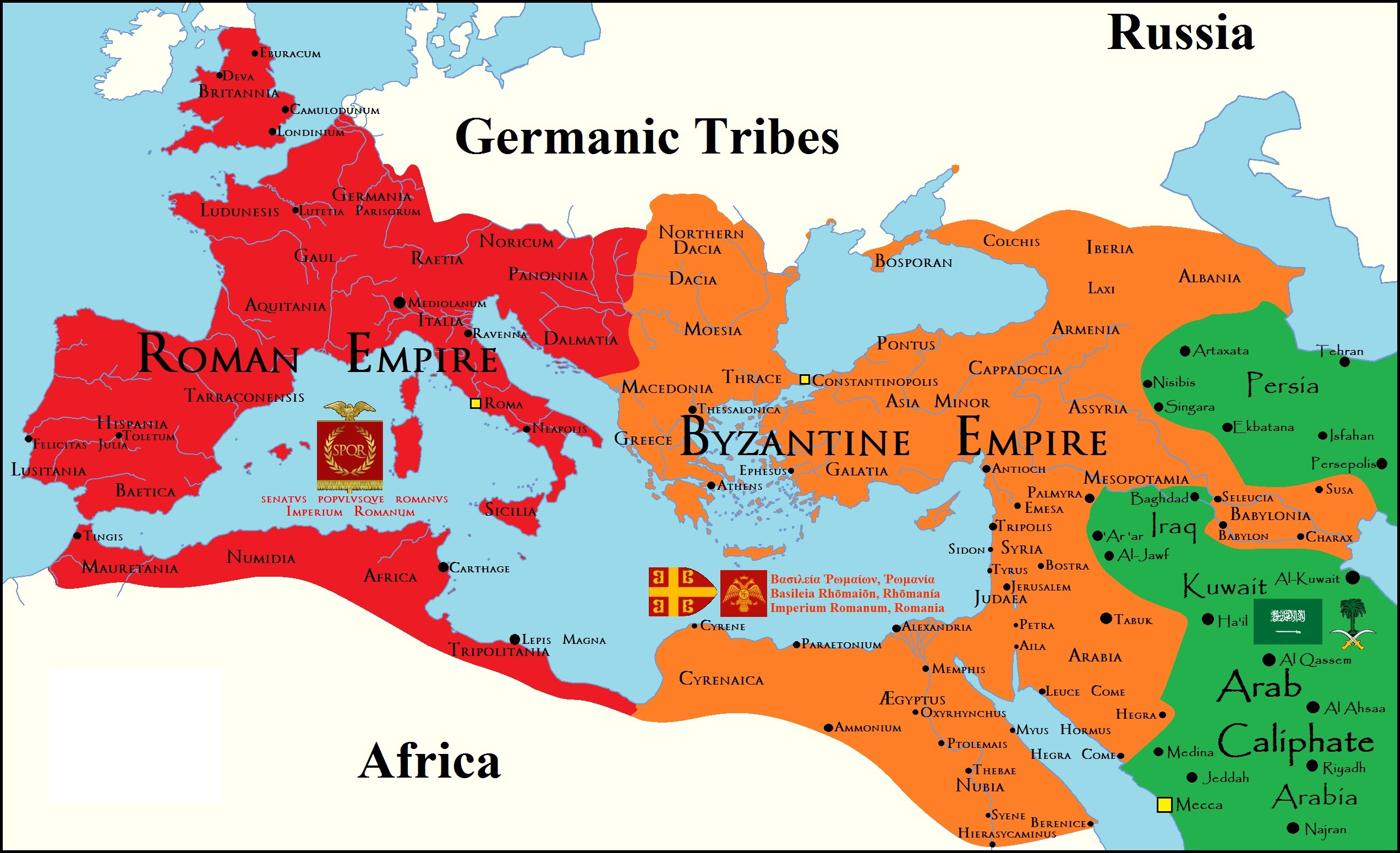 The Byzantine Empire was the continuation of the eastern portion of the Roman Empire after its division in the late 3rd century. (Click image to be taken to source) End of Byzantine Rule and the Islamic Conquest (638 CE) In the early 7th century, the Byzantine Empire was grappling with both internal instability and external threats. Among these challenges were the aggressive campaigns of the Sassanian Empire (Persia), which, at its height, sought to reclaim territories that had been lost to Rome and Byzantium. In 614 CE, the Persian army launched a major offensive into the Levant, culminating in the capture of Jerusalem. This event was significant because the Persians were aided by Jewish allies in the region, who saw an opportunity to assert their presence after centuries of Roman and Byzantine dominance. The Persians briefly ruled Jerusalem, allowing Jewish residents to return to the city, and for a short time, they even granted the Jews autonomy. However, the Byzantine Empire under Emperor Heraclius would not let the Sassanian victories go unchallenged. In 628 CE, Heraclius mounted a counter-offensive and successfully recaptured Jerusalem from the Persians, restoring Byzantine and Christian control over the city. Heraclius' victory was short-lived, however, as the Byzantine Empire had been severely weakened by its wars with Persia. The long and exhausting conflicts drained the empire's resources and left it vulnerable to new external pressures. One such pressure emerged almost immediately: the Islamic conquests. In 638 CE, just a decade after Heraclius' triumph, the armies of the Rashidun Caliphate, led by Caliph Umar, marched into Palestine and captured Jerusalem from the Byzantines. This marked the beginning of a new era of Islamic rule in the region. According to historical accounts, Caliph Umar entered Jerusalem peacefully, negotiating its surrender with Patriarch Sophronius, the Christian leader of the city. Upon taking control, Umar implemented policies of religious tolerance, exemplified by the Covenant of Umar, which guaranteed that Christians and Jews could continue practicing their faiths under Islamic rule. These religious minorities, known as dhimmis (protected non-Muslims), were required to pay a tax called the jizya in exchange for protection and the right to live peacefully in Muslim lands. This marked a contrast with the Byzantine rulers, who had often restricted Jewish access to Jerusalem and barred them from living there. The Islamic conquest of Jerusalem signaled a broader shift in the region. The Rashidun Caliphate continued its rapid expansion, capturing vast territories across the Middle East, North Africa, and parts of Europe. For Palestine, the Islamic conquest ushered in centuries of Muslim rule, with Jerusalem becoming a revered city in Islam. The significance of Jerusalem was due in part from its association with the Isra and Mi'raj, the Prophet Muhammad’s miraculous night journey and ascension to heaven. This connection further solidified Jerusalem as the third holiest city in Islam, following Mecca and Medina. The construction of the Dome of the Rock in 691 CE and the Al-Aqsa Mosque in 705 CE during the Umayyad period emphasized the city’s religious importance. This early period of Islamic rule set the foundation for future developments in the religious, political, and cultural identity of the region. Umayyad and Abbasid Caliphates (661–1258 CE)Umayyad Caliphate (661–750 CE) The Umayyad Caliphate, with its capital in Damascus, governed Palestine following the Rashidun period. Under Umayyad rule, Palestine experienced substantial urban development and architectural achievements. The most iconic project of this period was the Dome of the Rock, built by Caliph Abd al-Malik in 691 CE, a masterpiece of Islamic architecture and a symbol of Islamic dominance over Jerusalem. Similar to the Byzantine Empire, the Umayyads invested heavily in infrastructure, promoting agriculture and establishing trade routes that connected Palestine to the larger Islamic world. As part of the empire, the region became a critical hub for commerce between Africa, Asia, and Europe, integrating Palestine into the economic and cultural currents of the time. Abbasid Caliphate (750–1258 CE) The Abbasid Caliphate, based in Baghdad, succeeded the Umayyads, bringing a more centralized and bureaucratic administration. Though the Abbasids maintained control over Palestine, their focus shifted eastward, toward Iraq and Persia, which reduced the region's political importance. However, Jerusalem continued to be a key religious site for Muslims. By the 9th century, Abbasid control weakened, and regional dynasties like the Fatimids began exerting influence over Palestine. Nevertheless, the Abbasid period saw the continuation of intellectual and cultural exchanges, with Jerusalem remaining a significant religious and scholarly center. The Fatimid Caliphate & the Crusades (969–1291)Fatimid Caliphate (969–1171 CE) The Fatimids, a Shia Muslim dynasty based in Egypt, gained control of Palestine in the late 10th century. Their rule brought stability and economic prosperity to the region, though tensions between Sunni and Shia Muslims occasionally disrupted peace. The Fatimids, like the Rashidun and Umayyads, maintained a policy of religious tolerance, allowing Christians and Jews to practice their faiths and maintain their holy sites. However, under Caliph al-Hakim, this tolerance wavered. In 1009, al-Hakim ordered the destruction of Christian holy sites, including the Church of the Holy Sepulchre, creating significant tensions with the Christian world, and this act partly motivated the launch of the Crusades. The Crusades (1096–1291) The First Crusade was launched in 1096 by European Christians, responding to Muslim control of the Holy Land and the destruction of Christian sites. In 1099, the Crusaders captured Jerusalem, establishing the Kingdom of Jerusalem and other Crusader states across the Levant. Their brutal conquest resulted in the massacre of Muslim and Jewish inhabitants, deepening the animosity between the Abrahamic religions. For nearly a century, the Crusaders controlled Jerusalem, until Saladin, the Sultan of Egypt and Syria, defeated them at the Battle of Hattin in 1187 and recaptured the city. Saladin’s victory was celebrated throughout the Islamic world, and his policies of religious tolerance allowed Jews and Christians to return to Jerusalem, restoring a more peaceful coexistence. The Crusader states continued to exist in parts of Palestine and the Levant until the end of the 13th century. The Mamluks, a Muslim dynasty based in Egypt, eventually expelled the last Crusaders from the region in 1291, restoring Islamic control over Palestine. Mamluk Rule (1291–1517) The Mamluks ruled Palestine after defeating the Crusaders, with their empire centered in Cairo. Although Palestine remained a strategically important region, it experienced economic decline under Mamluk rule. Frequent wars, poor administration, and natural disasters weakened agriculture, the backbone of the economy, and reduced prosperity. Despite these challenges, the Mamluks remained devoted to maintaining the religious significance of Jerusalem. They undertook the restoration of religious sites, emphasizing Jerusalem’s role as a key Muslim holy city. Ottoman Rule (1517–1917)The story of the Ottoman Empire is a tale of extraordinary expansion, military conquests, cultural brilliance, and eventual decline. From its humble beginnings as a small Turkish principality, the empire grew into one of the most powerful forces in world history, shaping the political, social, and cultural landscape of the Middle East, Europe, and North Africa for over 600 years. Its control over Palestine, lasting nearly four centuries, had profound implications for the region, especially in the lead-up to modern conflicts. As we trace the history from the Ottoman conquest to its decline, we see a legacy of imperial ambition, religious tolerance, and eventual collapse that set the stage for the contemporary struggle between Israelis and Palestinians. The Rise of the Ottoman Empire: From Principality to Global Power The Ottoman Empire's roots trace back to the late 13th century, when a small Turkish principality, led by Osman I, began expanding into the territories of the crumbling Byzantine Empire. In 1453, the Ottomans, under Mehmed II (the Conqueror), captured Constantinople, renaming it Istanbul and transforming it into the capital of an empire that spanned three continents. This victory marked not only the end of the Byzantine Empire but also the establishment of the Ottomans as a dominant global power, ruling over diverse populations across a vast geography. The Conquest of Palestine (1517): A New Era of Ottoman Rule In 1517, the Ottomans, led by Sultan Selim I, defeated the Mamluk Sultanate in a series of decisive battles, bringing Palestine under Ottoman control. This conquest marked the beginning of nearly 400 years of Ottoman rule in the region, a period that saw the development of a unique administrative and religious structure that left a lasting impact on Palestine. Under the Ottomans, Palestine became part of the larger province of Syria, divided into smaller administrative districts known as sanjaks. The key districts were Jerusalem, Nablus, and Gaza, with Jerusalem holding special significance due to its religious importance to Muslims, Christians, and Jews. The Ottomans implemented the millet system, which allowed religious communities to govern themselves according to their own laws and customs. This system provided relative religious tolerance for Jews and Christians, while ensuring that the Muslim majority held certain privileges. The Golden Age: Suleiman the Magnificent and Cultural Flourishing The 16th century saw the Ottoman Empire reach its zenith under the reign of Suleiman the Magnificent (1520–1566). Suleiman presided over a period of immense territorial expansion, legal reforms, and cultural achievement. In Palestine, the most notable architectural legacy from this period is the rebuilding of the Walls of Jerusalem between 1537 and 1541. These walls, still standing today, reinforced Jerusalem’s position as a central religious and administrative hub in the empire. Suleiman's reign also saw the restoration of Islamic holy sites such as the Dome of the Rock and Al-Aqsa Mosque, further emphasizing Jerusalem’s religious significance. The Ottomans promoted peaceful coexistence among religious groups, allowing Christian pilgrims to visit the Church of the Holy Sepulchre and safeguarding Jewish communities in the city. A Long Decline: The Ottoman Empire in the 17th and 18th Centuries While the Ottoman Empire thrived during the 16th century, the 17th and 18th centuries were marked by stagnation and slow decline. Internally, the empire faced growing corruption, administrative inefficiencies, and local revolts. Externally, European powers like the Habsburgs and Russians chipped away at Ottoman territories, particularly in the Balkans and Eastern Europe. The 1683 Siege of Vienna, where the Ottomans failed to capture the city, marked the beginning of their retreat from Europe. In Palestine, the Ottoman grip weakened as local leaders gained more autonomy. The Ottoman governors in Palestine struggled to maintain control, while foreign powers, especially Britain and France, increasingly exerted influence in the region, often using their support for local Christian communities as a pretext for intervention. Tanzimat Reforms (1839–1876): A Last Attempt at Modernization As the 19th century unfolded, the Ottoman Empire, now dubbed the "Sick Man of Europe," faced increasing internal and external pressure. In an attempt to stave off further decline, the Ottoman government launched a series of reforms known as the Tanzimat. These reforms aimed to modernize the empire's military, administration, and economy, as well as grant greater rights to non-Muslims. In Palestine, the reforms led to:
The Egyptian Invasion (1831–1840) and British Influence In 1831, Muhammad Ali, the ambitious ruler of Egypt, invaded Palestine, temporarily taking control from the Ottomans. Muhammad Ali’s brief rule saw attempts at modernization, but his policies, such as heavy taxation and conscription, angered the local population. By 1840, European powers, particularly Britain and Austria, forced Muhammad Ali to withdraw, restoring Ottoman control. However, this event underscored the weakening authority of the Ottomans and the increasing role of European powers in shaping the fate of Palestine. The region’s strategic importance, especially due to its proximity to the Suez Canal, made it a focal point for European imperial ambitions. The Rise of Nationalism and Zionism in the Late 19th Century By the late 19th century, nationalist movements across the Ottoman Empire threatened its territorial integrity. In Palestine, two competing nationalisms--Arab and Jewish—began to take shape. The Zionist movement, spurred by rising antisemitism in Europe, particularly in Russia and Eastern Europe, advocated for the establishment of a Jewish homeland in Palestine. The First Aliyah (1882–1903) saw thousands of Jews immigrate to Palestine, purchasing land and establishing agricultural settlements. This growing Jewish immigration created tensions with the local Arab population, who feared losing their land and livelihood. Although the Ottoman authorities tried to regulate land sales and limit Jewish immigration, their declining power meant they could do little to stop these demographic changes. The Changing Borders of Israel/Palestine (1888-2023)  (Click image to be taken to source). World War I and the End of Ottoman Rule (1914–1918) The Ottoman Empire was in decline by the late 19th century, and various nationalist movements, both Arab and Jewish, began to emerge. These movements would become crucial in the events that followed the empire's collapse. The region, known as Palestine under Ottoman rule, had been part of the empire since the early 16th century. During this period, it was a largely rural and agrarian society with a mix of Arab Muslims, Christians, and a small Jewish population. During World War I, the Ottoman Empire sided with the Central Powers (Germany, Austria-Hungary), and when the Allies won the war, the empire was dismantled. In 1917, British forces, led by General Edmund Allenby, captured Jerusalem, and by the end of the war, Britain had control of much of the former Ottoman territories in the Middle East, including Palestine. World War I dealt the final blow to the Ottoman Empire. Aligning itself with Germany and the Central Powers, the Ottomans found themselves on the losing side of the war. In Palestine, the war saw the Arab Revolt (1916–1918), in which Arab forces, aided by Britain and led by T.E. Lawrence, rose up against Ottoman rule. By the war's end, British forces had captured Jerusalem in 1917, and the Ottoman Empire was dismantled. The Treaty of Sèvres (1920) formally partitioned the empire's territories, with Palestine placed under British control as part of the League of Nations Mandate system. This marked the end of over 400 years of Ottoman rule and the beginning of a new chapter in Palestinian history, one that would soon be marked by conflict and competing claims to the land. Sources
|
Archives
July 2025
AuthorAvee Allgood
|
 RSS Feed
